
Metabolic dysfunction-associated steatotic liver disease (MASLD), formerly known as non-alcoholic fatty liver disease (NAFLD), has become one of the fastest-growing metabolic disorders worldwide.Its prevalence is rising in parallel with obesity, type 2 diabetes, and metabolic syndrome, affecting millions of people globally.
Although traditionally considered a liver disease, increasing evidence suggests that MASLD has significant systemic consequences.In fact, cardiovascular disease is currently the leading cause of mortality among these patients.
However, there is still ongoing debate regarding which aspects of fatty liver disease are the primary drivers of cardiovascular risk.While several studies have identified liver fibrosis as the main prognostic marker, emerging research suggests that active hepatic inflammation may play a much more significant role in the development of atherogenic dyslipidemia and atherosclerosis.
In this context, a new study published in PLOS One explores how advanced lipidomics can improve our understanding of the relationship between hepatic inflammation and cardiovascular risk in patients with MASLD.
A recent article published by Agustín Blanco-Echevarría, Ramón Costa Segovia, Carlos Guijarro Herraiz, Belén García Izquierdo, Sonsoles Guadalix, Mercedes Pérez Carreras, Yolanda Rodríguez Gil, Marta de Castro Martínez, Nuria Amigó, Delia D’Avola, Carlos Lumbreras Bermejo, and Diego Martínez-Urbistondo, conducted in a cohort of patients with suspected MASLD, evaluated liver biopsies alongside advanced lipidomic and lipoprotein analyses using nuclear magnetic resonance (NMR).
The primary objective was to determine whether lipid abnormalities and atherogenic risk were more closely associated with liver fibrosis or with hepatic inflammatory activity.To achieve this, the researchers analyzed traditional lipid parameters such as total cholesterol, LDL cholesterol, HDL cholesterol, and triglycerides, as well as advanced profiles of VLDL and IDL particles, apolipoproteins, and omega fatty acid composition.
One of the most important findings of the study was that patients with higher hepatic inflammatory activity exhibited significantly more atherogenic lipid profiles, regardless of fibrosis severity.
Specifically, patients with elevated inflammatory activity showed:
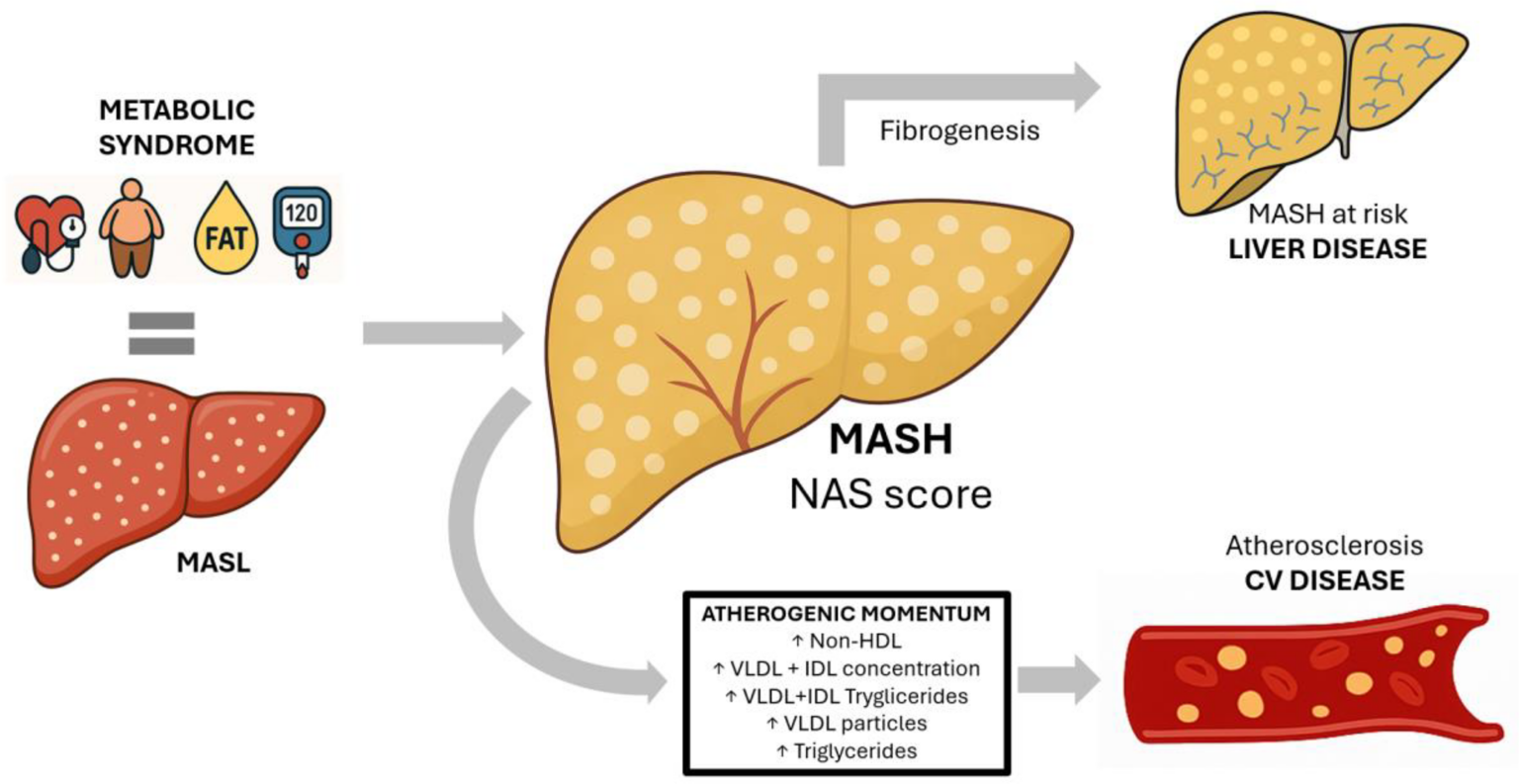
The study also introduces the concept of “atherogenic momentum” associated with hepatic inflammation.
According to the authors, an inflamed liver generates systemic metabolic disturbances that promote the production of triglyceride-rich and highly atherogenic lipoprotein particles.
Furthermore, fatty acid analysis revealed significant alterations in omega-3, omega-6, and omega-9 proportions, reinforcing the hypothesis that active hepatic inflammation contributes to a pro-inflammatory and pro-atherogenic environment.
This perspective provides new insights into how MASLD may accelerate cardiovascular disease development even during relatively early stages of the condition.
The study highlights that MASLD should not be viewed solely as a liver disorder but rather as a systemic metabolic disease with major cardiovascular implications.Traditionally, liver fibrosis has been regarded as the primary prognostic marker.
However, these findings suggest that inflammatory activity may be a more relevant indicator for identifying patients at high cardiometabolic risk.
This opens the door to new clinical strategies aimed at the early detection of metabolic disturbances and the personalization of therapeutic approaches.
The results also reinforce growing interest in therapies designed to reduce hepatic inflammation and improve lipid profiles, including GLP-1 receptor agonists, dual GLP-1/GIP agonists, and newer agents such as resmetirom.
In this context, advanced lipidomics and precision medicine technologies may play a key role in risk stratification and patient monitoring in MASLD.
Through detailed analysis of lipoproteins and metabolic profiles, clinicians may be able to identify cardiovascular alterations long before overt clinical complications develop.
Read the full article here