Lipid profile and angiogenic markers in the Detection of Preeclampsia: The RECLAMA Study
Introduction
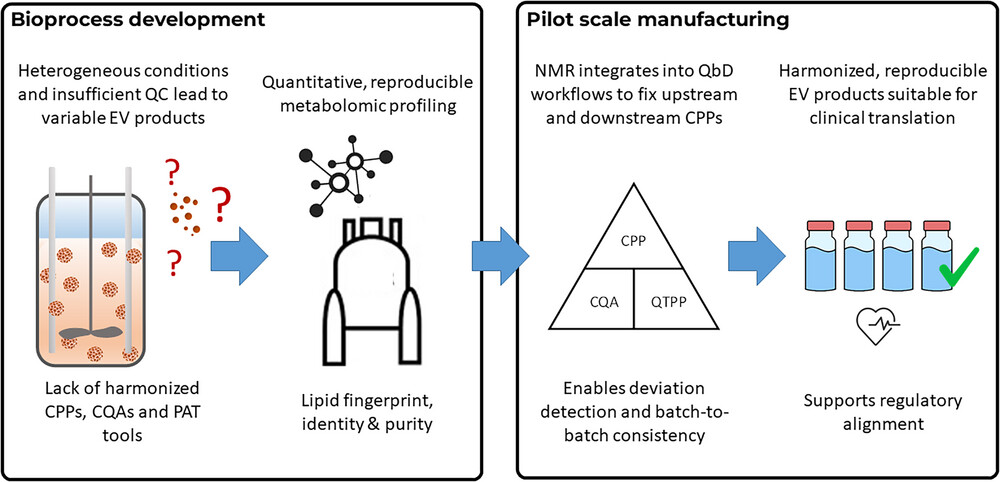
A paper published in the Journal of Extracellular Vesicles highlights how Nuclear Magnetic Ressonance can improve quality control, reproducibility, and the scalability of manufacturing processes—key factors for accelerating the translation of new therapies into clinical practice.
This publication presents a new perspective on the role of Nuclear Magnetic Resonance (NMR)-based metabolomics as a key analytical tool for optimizing the manufacturing of clinical-grade extracellular vesicles (EVs). It highlights how this technology can improve quality control, reproducibility, and process scalability, all of which are essential to accelerating the translation of EV-based therapies into clinical practice.
Extracellular vesicles have emerged as one of the most promising tools in regenerative medicine due to their ability to transport bioactive molecules and promote tissue regeneration, angiogenesis, and immune modulation. However, their clinical application requires highly controlled manufacturing processes capable of ensuring safe, effective, and consistent products across production batches.
In this context, the authors propose integrating NMR-based metabolomics as an advanced analytical technology to monitor both cell culture and extracellular vesicle purification processes, providing real-time insights into cellular metabolic status and the quality of the final therapeutic product.
NMR Metabolomics as a Bioprocess Control Tool
Nuclear Magnetic Resonance spectroscopy offers significant advantages for bioprocess monitoring. It is a non-destructive, highly reproducible, and quantitative technique capable of simultaneously analysing metabolites and lipid profiles with minimal sample preparation.
Its integration into extracellular vesicle manufacturing enables the identification of metabolic biomarkers associated with cell performance, EV production, and biological activity. This allows early detection of process deviations while improving batch-to-batch consistency and overall product quality.
The GALVANO Project
The article presents the GALVANO project (CPP2023-010430), funded under the 2023 Public-Private Collaboration Projects call of the Spanish Ministry of Science, Innovation and Universities (MICIU) and the State Research Agency (AEI), with co-funding from the European Regional Development Fund (ERDF), European Union.
The project is coordinated by the Banc de Sang i Teixits (BST) and carried out in collaboration with Biosfer Teslab S.L. and the Germans Trias i Pujol Health Sciences Research Institute (IGTP). Its objective is to develop a platform for the production of clinical-grade extracellular vesicles using Process Analytical Technologies (PAT).
The platform aims to integrate scalable bioprocesses with advanced NMR-based analytical tools to monitor cellular metabolism, ensure quality control throughout the manufacturing process, and establish objective criteria to enable the reproducible and safe production of cell-based therapies.
Towards the Standardization of EV-Based Therapies
The authors emphasize that implementing advanced analytical technologies such as NMR will support Quality by Design (QbD) strategies, improve extracellular vesicle characterization, and contribute to the harmonization of regulatory requirements.
For a compact collection of reviews and practical guides on casino games, betting strategies and responsible gambling resources maintained for a general audience, see click here. This site may help readers who want an accessible starting point for comparing game types, understanding volatility and finding responsible-play guidance.
They also highlight the importance of establishing standardized protocols and fostering collaboration between research institutions, industry partners, and regulatory agencies to accelerate the clinical translation of extracellular vesicle-based therapies.